
Can AI recruiting automation cut a 60-day time-to-hire in half without shipping worse candidates? Yes, if you draw the line correctly between what machines screen and what humans decide. Gartner reports that 61% of HR leaders were already deep in generative AI rollouts by January 2025. The teams pulling ahead treat AI as the operations layer for sourcing, parsing, and scheduling, then keep human judgment on the offer and the culture call. Having built these stacks for SaaS teams since early 2024, we have found the AI model is rarely the bottleneck. Hiring-manager approval queues are.
What AI recruiting automation actually handles in 2026
AI recruiting automation in 2026 covers the full coordination layer: sourcing, resume parsing, first-pass screening, scheduling, and interview note capture. McKinsey 2026 research documenting 80% time-per-hire reductions found these stages are the primary automation target. The delivery model has shifted from single-tool assistants to multiagent stacks, with different models handling different stages of the hire.
Where AI still falls short is judgment work: reference checks, cultural fit reads, compensation negotiation, and any decision that must survive a lawsuit. AI candidate screening software can rank 3,000 applicants against a job spec in minutes. It cannot tell you whether a candidate will thrive under your VP of Engineering. Treating that boundary as a religion is what separates teams that get real time-to-hire reduction with AI from teams that generate compliance risk.
The other capability worth naming is unstructured signal capture. Modern platforms transcribe screens, summarize themes across candidate cohorts, and flag pattern breaks (for example, five strong candidates in a row failing the same take-home). That feedback loop was previously buried in individual recruiter notebooks.

| Task | AI ready | Human required |
|---|---|---|
| Sourcing across LinkedIn and GitHub | Yes | Sample audit only |
| Resume parse and structured extraction | Yes | Rare edge cases |
| First-pass screen against job spec | Yes | Sample audit |
| Scheduling and rescheduling | Yes | No |
| Take-home evaluation | Partial | Yes |
| Culture and values interview | No | Yes |
| Reference calls | No | Yes |
| Offer negotiation | No | Yes |
For a closer look at this, see LinkedIn outreach automation in 2026: a B2B playbook.
For a closer look at this, see AI invoice processing automation: cut AP cycle time by 80% in 2026.
For a closer look at this, see AI sales automation ROI in 2026: the numbers your CFO needs to see.
For a closer look at this, see CRM automation with AI agents for SaaS teams: a complete 2026 guide.
For a closer look at this, see AI procurement automation B2B SaaS: the full 2026 operator guide.
How AI recruiting automation reduces time-to-hire in practice
Time-to-hire reduction with AI comes from three compressions: source-to-shortlist, shortlist-to-interview-slot, and interview-to-decision. Each has a different lever. McKinsey has reported that some organizations running end-to-end multiagent stacks (sourcing, screening, and scheduling handled by AI) have cut time-per-hire by up to 80%.
Source-to-shortlist gets faster because AI scores inbound and outbound simultaneously against structured criteria pulled from the job description. Shortlist-to-interview compresses because AI schedulers eliminate the calendar tennis that historically eats days. Interview-to-decision moves faster because AI summarizes panel notes into a comparable rubric within minutes.
None of this matters if the pipeline still stalls at a hiring manager who signs off at their leisure. That is why the ROI on AI recruiting automation is a systems question, not a tools question. Every automated stage exposes the next human bottleneck. Teams that do not restructure downstream approvals capture roughly a third of the theoretical gain, based on 2026 Forrester field data.

An end-to-end AI recruiting automation workflow for B2B SaaS
A Series B+ SaaS company hiring engineers, GTM leaders, and CS staff can wire AI recruiting automation into a single workflow that starts at intake and ends at offer. McKinsey 2026 research shows end-to-end multiagent coverage is what separates firms achieving 80% time-per-hire reductions from teams capturing only a fraction of that gain. The order:
- Intake and job spec: hiring manager fills a structured brief; AI expands into a competency rubric.
- Sourcing: AI agents query LinkedIn, GitHub, past ATS records, and referral graphs against the rubric.
- Screening: an AI talent acquisition platform ranks candidates against the rubric and flags the top decile.
- Outreach and scheduling: personalized outbound at scale, calendar coordination handled by an AI scheduler (see our AI scheduling agent guide).
- Interview kit: AI generates interview questions per stage tied to the rubric.
- Debrief: interviewers write freeform notes; AI compiles them into a comparable rubric.
- Reference and offer: back to humans.
The critical joint is the rubric. If the rubric is vague, every downstream automated step compounds noise. A senior recruiter tightening the rubric for a week saves more time than any tool purchase. This is the same pattern documented in our AI agent implementation playbook: start narrow, measure, then widen. It is also why the buy-versus-build call matters early; see our build vs buy framework before you sign an annual contract.
Measuring ROI on AI recruiting automation
ROI on AI recruiting automation is not cost-per-hire. It is time-to-productive-offer multiplied by offer-acceptance rate, adjusted for candidate NPS. Gartner projects 50% of HR activities will be AI-run by 2030, and the teams measuring all three components now will have the baseline that proves their stack's value when that shift arrives.
Harvard Business Review has documented cases where speed-optimized funnels dropped acceptance rates because candidates felt processed by a machine. That is the real cost of overrotation. Track these numbers monthly, and instrument like you would a paid growth channel (see our note on measuring AI agent performance):
- Time-to-first-interview
- Time-to-offer
- Offer-acceptance rate
- 90-day retention
- Candidate NPS (yes, survey them; it is not fluff)
- Cost per interview loop
Compliance, bias, and candidate trust in AI hiring
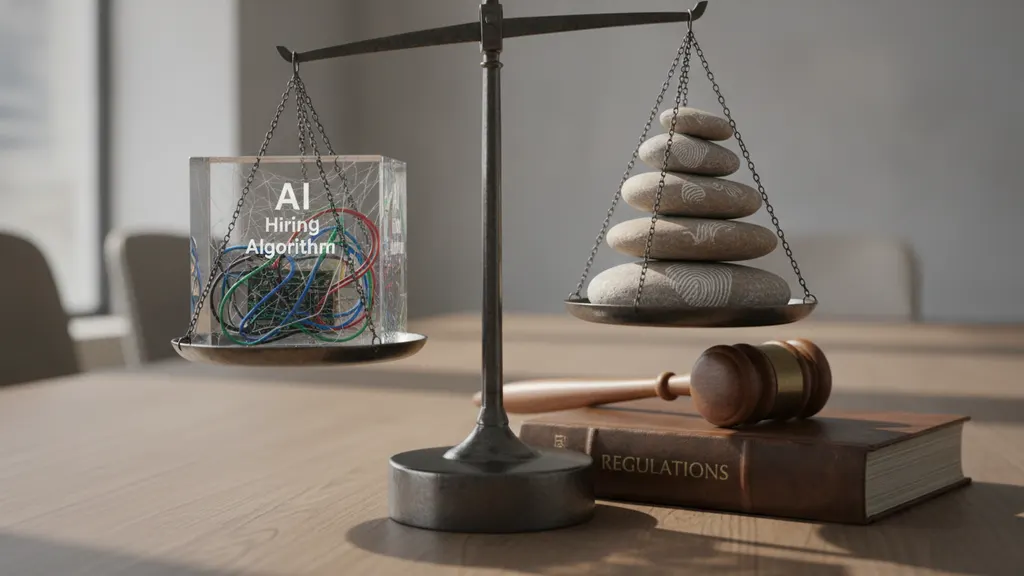
Only 26% of applicants trust AI to evaluate them fairly, even though 52% believe AI is already reading their applications, per Gartner 2025. The EU AI Act classifies most hiring uses as high-risk, and NYC Local Law 144 mandates bias audits for automated employment decision tools.
Reuters has covered enforcement waves at large employers across 2025 and 2026, and the patterns are consistent: organizations that treated audit obligations as afterthoughts faced the consequences first. Real risk reduction requires a documented operating system, not a vendor checkbox. Publish a plain-English candidate notice describing what AI does and does not decide in your hiring process. Retain audit logs for every adverse decision and give candidates a clear path to request human review; staff that path so it actually works. Bias-test your models quarterly against protected classes and publish the methodology and disparate-impact results, not just internally but on request to candidates. Restrict training data to signals the vendor can document, not everything your ATS ever collected. Companies that treat every one of these steps as a positioning asset rather than a compliance chore close more candidates. Transparency is a conversion lever, not a tax. Candidates at the level you are hiring for are researching your company before they apply; make the AI story an argument for joining, not something they uncover in a Glassdoor thread.
For the wider systems-thinking pattern, read our take on AI workflow automation for SaaS: the mistake is always the same, treating automation as a toolset rather than an operating model.
Frequently asked questions
Can AI recruiting automation replace human recruiters entirely?
No, and framing it that way is why implementations stall. AI recruiting automation replaces the coordination layer (sourcing, parsing, scheduling, first-pass screening) so recruiters can spend time on the parts that move offer acceptance: relationship building, negotiation, and closing. Gartner 2025 data shows 61% of HR leaders are deep in generative AI rollouts, and the successful ones position AI as help for human judgment, not a replacement. Teams that lay off recruiters then hand the roster to AI typically see quality-of-hire drop within two quarters.
How long does it take to deploy an AI recruiting automation stack?
A focused pilot runs 30 to 60 days for a single role family (for example, engineering or GTM). A full rollout across all req types is 6 to 9 months, gated by ATS integration, HRIS data cleanup, and hiring-manager training. McKinsey 2026 case studies show the fastest movers restrict scope in the first quarter, prove the numbers, then widen. Firms that try to boil the ocean typically end year one with expensive infrastructure and no time-to-hire gains to show for it.
What does AI recruiting automation cost to run at a Series B SaaS company?
Ranges vary widely. Independent AI candidate screening software often lands in the low tens of thousands per year for a mid-size team, while integrated AI talent acquisition platforms can run higher with services and integration attached, per Forrester coverage. What matters more is the internal cost: rubric design, model tuning, and change management. Gartner 2025 data suggests the majority of failed HR AI projects stall on adoption, not licensing. Budget at least as much for enablement as for software, and do not declare success until hiring managers are actually using the output.
Does AI in hiring introduce bias, and how do you audit for it?
It can, and pretending otherwise is why companies get sued. Any model trained on historical hiring data inherits the biases in that data. Mitigation requires quarterly audits against protected classes, a documented human-review path, and adherence to statutes like NYC Local Law 144 and the EU AI Act. Reuters has covered active enforcement waves in 2025 and 2026. Real risk reduction comes from process design, not vendor promises. Ask any vendor to show you their audit methodology and disparate-impact test results before signing.
How do we win candidate trust while using AI in hiring?
Only 26% of applicants trust AI evaluations today, per Gartner 2025. Trust comes from transparency: publish a plain-English notice explaining what AI does and does not decide, guarantee a human review path for adverse decisions, and share a clear timeline. Companies treating this as a positioning asset rather than a compliance chore report higher acceptance rates. The candidates you want are researching you; make the AI story an argument for joining, not something they have to discover in a Glassdoor thread.
What ROI should we expect from AI recruiting in year one?
Realistic year-one targets: 30 to 50% reduction in time-to-first-interview, 20 to 30% reduction in total time-to-offer, and cost-per-hire savings of 15 to 25%, per benchmarks published by MIT Technology Review and Forrester. Top-performing firms with mature multiagent stacks have hit 80% time-per-hire reduction per McKinsey 2026, but they are outliers with heavy engineering investment. Do not benchmark against them in year one. Benchmark against your own baseline three quarters earlier, and instrument every step so you can prove the delta.