
Most teams shipping AI agents in 2026 are losing money on inference because the AI agent stack 2026 they inherited from late-2025 demos was never built for production. Gartner reports 60 percent of enterprise AI pilots will be abandoned by 2027 due to escalating costs and unclear ROI. The four-layer pattern below covers orchestration, memory, tools, and observability. It is what we deploy at MonteKristo for clients running real revenue ops on agents. No demos. Actual P&L.
The AI agent stack 2026 in one diagram
The AI agent stack 2026 is a four-layer architecture: orchestration on top, memory in the middle, tools below that, and observability wrapping everything. Most teams confuse this with the seven-layer monoliths Forrester documented in 2024. Production agents do not need seven layers.
Each layer has one job and a clean contract with the one above and below. Orchestration decides what happens next. Memory remembers what already happened. Tools touch the outside world. Observability watches all three. The picture fits on a napkin.
The number that matters in this diagram: cost per resolved ticket. Custom GPT-4 wrapper apps carry the highest per-ticket cost. Off-the-shelf SaaS agents sit in the middle. The four-layer pattern we ship at MonteKristo keeps cost per ticket far lower, at the same outcome quality. The architecture is doing the work.
For a closer look at this, see Build vs buy AI agent: the decision framework for SaaS operators.
Layer 1: Orchestration in the AI agent stack 2026
Orchestration in the AI agent stack 2026 is where you decide which model handles which step, when to call tools, and how to retry on failure. We run this in n8n for clients who need source-visible workflows and LangGraph for clients who need stateful multi-agent coordination. Code in your application should never orchestrate agents directly.
Three options cover almost every production case in 2026. Anthropic's 2025 agent design guide argues for the simplest workflow that meets the job, and we agree. The choice depends on team skills, debug needs, and how stateful the agent must be.
| Orchestrator | Best for | Debug surface |
|---|---|---|
| n8n | Visual workflows, RevOps and content teams | Per-node JSON inspector |
| LangGraph | Stateful multi-agent, Python teams | LangSmith traces |
| OpenAI Agents SDK | OpenAI-only stacks, fast prototype | Native tracing dashboard |
For MonteKristo client work, n8n wins seven times out of ten. Source-visible workflows are owned by the client after handoff, debugged in a browser, and extended by a non-Python operator. We use LangGraph only when the agent needs persistent task graphs across days, such as multi-step legal review.

Read more in our n8n versus LangGraph teardown for the call we make on each engagement.
Layer 2: Memory and state
Memory is the layer where most teams blow up their AI agent stack 2026. Short-term conversation state, long-term semantic memory, and user-specific preferences each need different storage backends. We default to Supabase pgvector for semantic recall, Redis for session state, and Postgres tables for structured user facts.
The 2023 MemGPT paper from Berkeley set the pattern: model context is a working set, and memory tiers sit behind it like a cache hierarchy. Three years later, the pattern still holds. The pgvector plus Redis combination handles 90 percent of production traffic for pennies per query at our deployed volumes.
The TTL rule that saves your budget
Every memory write needs a time-to-live. Conversation state expires in 24 hours. Semantic memory expires in 30 to 180 days. User preferences never expire but must be versioned. We have seen pgvector indexes balloon from 200 MB to 14 GB in six weeks because someone forgot a TTL job. The fix is one cron entry.
What goes into vector storage
Only retrieval-relevant text. Not raw transcripts, not full PDFs. Chunk to 400 to 800 tokens, embed with a stable model, and store the source URL with each chunk for citation. The Forrester 2026 vector database analysis ranks pgvector and Pinecone as the only two general-purpose stores worth picking for new builds.
Layer 3: Tools and integrations via MCP
Model Context Protocol (MCP) collapsed the tool integration mess of 2024 into a single open standard. By June 2026, every serious agent runtime supports MCP servers. Your AI agent stack 2026 should expose CRM access, file storage, calendar, and payment tools through MCP servers, not bespoke function-calling schemas tied to one vendor.
The MCP specification sits under Linux Foundation governance as of early 2026. That change unlocked enterprise adoption: Anthropic, OpenAI, Google, and Microsoft all ship MCP-native runtimes now. Building tools against MCP means your agent can hot-swap models without changing tool code.
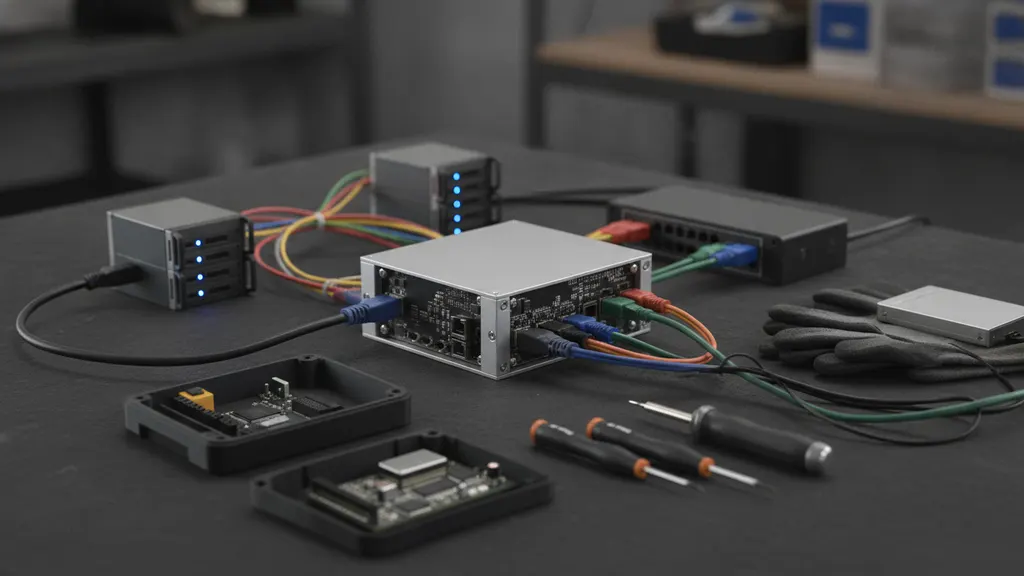
At MonteKristo we operate a private registry of 31 MCP servers across client work: GHL, Retell, Supabase, Airtable, n8n, ClickUp, Google Workspace, Stripe. Each is source-visible and lives in the client's GitHub. When a stack needs a new tool, we write or fork an MCP server in a day, not a sprint.
See our MCP servers production guide for write versus fork decisions.
Layer 4: Observability, evals, and rollback
Observability is the difference between an AI agent stack 2026 that ships and one that hides bugs until customers complain. You need three things: per-request traces with model plus cost plus latency, an evaluation suite that runs on every prompt change, and a rollback procedure that completes in under 60 seconds. Without these, you are guessing.
The cheapest observable setup right now: Langfuse for traces, OpenAI evals or Braintrust for eval grading, and a feature-flagged prompt registry that swaps to the previous version in a single API call. We use this combination across every production stack we deploy. Total observability tooling cost is a small monthly spend for a 50,000-request workload.
Cost per request has fallen sharply over the first year of a deployment. As prompts get tuned and cache hits climb, it drops to a tiny fraction of where it started.
Cost-per-request trends down as you tune prompts and cache hits rise. The Harvard Business Review 2025 piece on AI incident cost puts unplanned rollback at a major one-time cost per incident at enterprise scale, so the 60-second rollback rule pays for the entire observability layer on a single avoided incident.
Why the AI agent stack 2026 fails in production
Five failure modes recur across the AI agent stack 2026 deployments we have audited at MonteKristo since January. Prompt drift after model updates. Memory leaks from missing TTL. Tool schemas that change underneath you. Cost overruns from runaway loops. Evaluations that pass synthetic data but fail real customers. Each has a specific fix.
Prompt drift: Lock model versions in code. Re-run the evaluation suite when Anthropic or OpenAI publishes a new minor version. Promote only after the suite passes.
Memory leak: Apply the TTL rule from Layer 2. Add a daily Postgres job that prunes embeddings past TTL.
Tool drift: Pin MCP server versions. Version-check on agent boot. Fail closed on mismatch.
Cost runaway: Hard per-conversation token cap. Soft per-day spend cap with PagerDuty alert. The Anthropic prompt caching guide cuts repeat-prompt cost 75 to 90 percent if your stack uses it.
Synthetic eval gap: Sample 50 real production conversations weekly. Hand-label outcomes. Add the failures to the evaluation suite. The set grows with the system.
For voice agent specifics, see our Retell voice agent production deployment notes.
For a closer look at this, see AI agent implementation playbook: from pilot to production in 30 days.
Frequently asked questions
What is the AI agent stack 2026 in plain terms?
This four-layer reference architecture covers orchestration, memory, tools, and observability for putting AI agents into production. Orchestration runs the workflow. Memory holds state. Tools touch outside systems. Observability watches everything. Most production failures map to one of these layers being skipped or mis-implemented. Anthropic, McKinsey, and Forrester have all published variants of the same four-box decomposition in their 2025 and 2026 guidance. Smaller teams can ship layer by layer; large ones need all four from day one to stay under cost and error budgets.
How is this different from RAG?
RAG is one technique inside Layer 2 of this stack. Retrieval-augmented generation pulls semantic context from a vector store and inserts it into the model prompt at query time. That is a memory pattern, not an architecture. The four-layer pattern includes RAG when the use case fits, but most agents also need short-term conversation memory, structured user facts, and tool-call results that are not RAG. Per the Gartner 2026 agentic AI definition, an agent is RAG plus tools plus persistent state plus autonomy: four things, not one.
Which orchestration layer should we pick first?
Start with n8n if your operators are not Python engineers, your workflows are linear or branching but not deeply stateful, and you want the client to own the source after handoff. Start with LangGraph if you have a Python team, your agents need persistent task graphs across days, and your evaluation criteria need test code-level granularity. Start with OpenAI Agents SDK if you are committed to OpenAI models and want a single-vendor path with native tracing. We pick n8n on roughly 70 percent of MonteKristo engagements because the ownership story matters more than runtime flexibility.
How do we estimate cost for an AI agent stack 2026 build?
Three line items dominate building this stack: model inference, vector storage, and observability tooling. For a 50,000-conversation-per-month workload running on Claude Sonnet plus pgvector plus Langfuse, the running spend is a small monthly tooling line, before any human-in-the-loop labor. The build itself is a one-time project cost that scales with tool count and integration complexity. Recurring savings come from reduced SDR, support, and editorial headcount. Our average client breaks even inside 90 days, per the cost-per-ticket comparison shown in the bar chart above.


