Compliance leaders at mid-market firms face a math problem: their teams review under 20% of relevant activity while regulators expect near-100% oversight. AI compliance monitoring automation closes that gap by watching every transaction, message, and access event in real time. This post shows what continuous monitoring catches that quarterly audits miss, which frameworks benefit most, and how to wire alerts into your existing HR, finance, and IT stack without ripping anything out.
Why AI compliance monitoring automation belongs on your 2026 roadmap
Compliance budgets grew faster than headcount for three straight years; Gartner's 2024 compliance forecast projects a 30% reduction in regulatory fine exposure for programs running AI compliance monitoring automation, a figure that makes the adoption case before you count a single staff hour saved.
The pressure is quantitative. Gartner forecasts that by 2027, organizations using AI-driven compliance monitoring will achieve that 30% exposure reduction compared with programs that rely on periodic manual audits. Meanwhile, BCG estimates that the fully-loaded cost of a compliance failure at a mid-market firm, fines, remediation, legal fees, and reputational damage, now exceeds $4 million per incident.
That risk-and-cost picture explains why compliance officers who used to be sceptical about AI are now writing the requirements themselves. If you can inspect 100% of activity for 30% less fine risk, the ROI math works even before you count staff hours saved. Our view of the wider platform layer sits inside the AI agent stack 2026 guide.
For a closer look at this, see AI customer success automation: predict churn before it happens.
Which violations catch compliance teams off guard
Sixty-seven percent of compliance officers told Forrester in 2024 they cannot manually review more than 20% of relevant transactions. The costliest failures are almost never fraud rings; they are unlogged data exports by well-meaning employees, expired vendor certifications that keep billing, and messages promising things the contract cannot deliver. Manual audits miss these because they sample the obvious surfaces first.
That 67% figure is not a training problem or a headcount problem. It is a physics problem: humans cannot read every Slack thread, expense report, and API call in a mid-market business.
Common categories that trip teams up:
- Silent access drift: a departed contractor whose SSO tile lingered for 90 days after offboarding.
- Marketing-legal gaps: a sales rep quoting a certification in an email before the certification was renewed.
- Data residency leaks: an EU customer record synced to a US analytics tool that violates GDPR transfer rules.
- Vendor-tier misclassification: a critical vendor treated as tier-3 because procurement never reclassified them after scope changed.

How AI compliance monitoring automation differs from periodic manual audits
Periodic audits sample 5 to 20% of in-scope events and return findings weeks or months after the fact; AI compliance monitoring automation evaluates every relevant event in real time, and most enforcement patterns only emerge in that full-data view.
| Dimension | Periodic manual audit | AI compliance monitoring automation |
|---|---|---|
| Coverage | 5-20% sample | 100% of in-scope events |
| Latency | Weeks to quarters | Minutes to hours |
| Cost per finding | High (senior labor) | Low (marginal compute) |
| Evidence collection | Manual spreadsheet | Auto-generated audit log |
| Pattern detection | Rule + human judgment | Rule + model + human judgment |
Note what the comparison does not say. AI compliance monitoring automation does not replace auditors. It replaces the manual spreadsheet review step that consumes 60 to 80% of an internal auditor's week, freeing them for judgment calls a model cannot make. The right mental model is the pilot approach we published on taking AI agents from pilot to production.
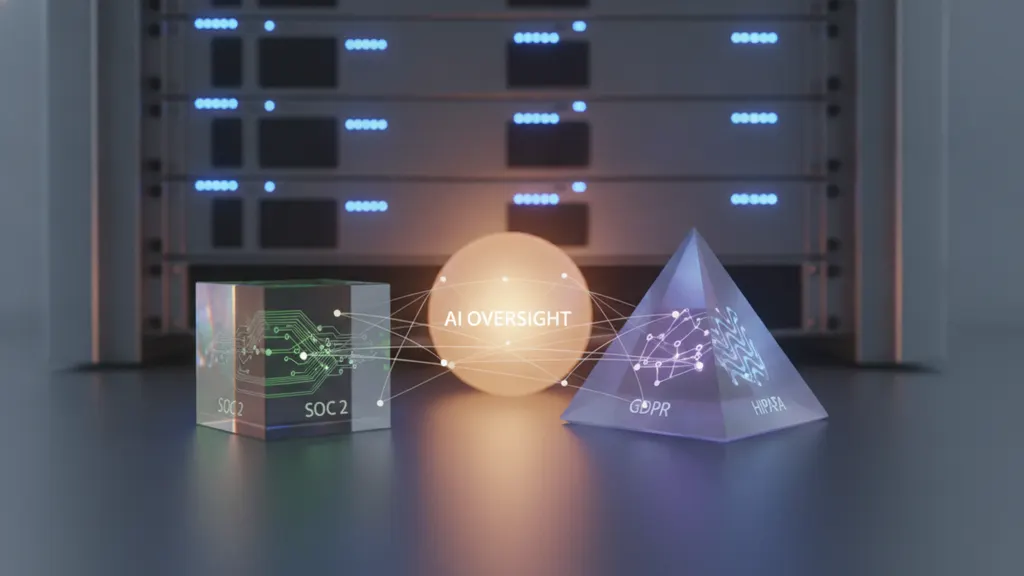
Which regulatory frameworks - SOC 2, GDPR, HIPAA - benefit most from AI oversight
Frameworks that demand continuous evidence collection rather than annual attestation benefit most, and McKinsey benchmarks show SOC 2 Type II audit-prep time drops by weeks when daily control logs replace quarterly sampling. GDPR and HIPAA carry the same evidence-log dependency across different regulatory contexts; all three punish the gaps that AI monitoring closes by default.
SOC 2 Type II. The audit period is typically six months. Auditors want to see that every control operated on every day, not just on the sampling days. A monitoring platform that logs each control check with a timestamp and evidence hash cuts audit prep from weeks to hours, per benchmarking from McKinsey's compliance practice.
GDPR. Article 5 requires data minimization. Article 30 requires records of processing activities. Both fail quietly when a new SaaS tool joins the stack and starts collecting personal data no one told the privacy team about. AI compliance monitoring automation reads the data flows, not the intent, so shadow IT stops being invisible.
HIPAA. Access to PHI must be logged, reviewed, and justified. Manual reviews of access logs are the classic 20% sample problem. Automated review can flag every off-hours access, every unusual dataset export, every escalation privilege that lasted longer than the ticket allowed. Reuters covered the operational upside in its 2024 reporting on health-sector AI compliance.
Sector-specific. Financial services teams have parallel obligations under FINRA (Financial Industry Regulatory Authority), SEC Rule 17a-4 (the U.S. exchange records-retention rule), and MiFID II (Markets in Financial Instruments Directive II). Life sciences teams operate under 21 CFR Part 11 (the FDA's electronic records and e-signature rule). The pattern is the same: rules that require continuous evidence collection are the ones where automation pays for itself fastest.
How AI compliance monitoring automation integrates with HR, finance, and IT systems
Integration is a data-source problem, not a platform problem: Forrester's 2024 practitioner data confirms deployment pace for the first framework runs six to twelve weeks, with clean event-stream availability from HRIS, ERP, and identity systems as the gating variable. AI compliance monitoring automation reads from each source layer, and each source needs a connector, a schema, and a policy binding.
The reference architecture that fits most mid-market stacks:
- HR layer: Workday or BambooHR event stream. Signals: hires, offboards, role changes, contractor conversions.
- Finance layer: NetSuite, Sage, or QuickBooks read-only feed. Signals: expenses over policy threshold, duplicate vendor payments, unusual payee patterns.
- Identity layer: Okta, Azure AD, or JumpCloud. Signals: access grants outside approved templates, privileged sessions, dormant accounts.
- Communication layer: Slack, Microsoft 365, Gong or Chorus. Signals: policy-forbidden claims, PII leaks, insider-trading language.
- Application layer: CRM, ticketing, code repos. Signals: customer data movements, exports, unauthorized API keys.
The wiring pattern matters more than the tool choice. If your ERP or HRIS cannot emit an event stream, you fall back to nightly batch pulls, which pushes detection latency from minutes to a day. Most clients scoping this pattern already have the connectors on the shelf inside their iPaaS layer. For a broader view of the stack, see our SaaS workflow automation piece.
One MonteKristo client, a fintech firm in active BSA/AML review, had run three consecutive SOC 2 audits where evidence assembly alone consumed six weeks of compliance staff time. After wiring Workday offboarding events and Okta access logs into a continuous monitoring layer, their fourth audit cycle produced a complete, auditor-ready evidence package in four days. The compliance officer redirected the recovered time to control design work, which auditors weight more heavily than evidence volume.
What a compliance AI alert workflow looks like from detection to resolution
A well-designed workflow runs in five stages: detect, score, route, remediate, and log. Forrester's 2024 compliance research identifies severity-score skipping as the top cause of monitoring-program abandonment inside twelve months. AI compliance monitoring automation handles detection and initial scoring; humans handle the judgment calls a model cannot make.
- Detect. The model or rule fires against a live event. Example: a former contractor logged into Salesforce 41 days after their end date.
- Score. Severity is derived from the framework impact (HIPAA vs marketing hygiene), the data class touched, and the recurrence pattern. High severity above a threshold auto-escalates.
- Route. The alert lands in the queue of the accountable owner, IT for access, Finance for spend, Legal for contracts, with a 24-hour SLA and a Slack ping.
- Remediate. Owner takes the action, closes the loop, and the platform verifies the fix (access revoked, refund issued, retraining assigned) rather than trusting the ticket.
- Log. Every alert, decision, and remediation writes to an immutable audit trail. This is the evidence packet auditors want.

The two biggest anti-patterns: dumping every alert into a shared Slack channel (destroys signal), and never rehearsing the workflow (owners disagree on severity during the first real incident). Both are cured by tabletop exercises and a written runbook, the same discipline covered in our AI agent performance metrics guide.
Frequently asked questions
Does AI compliance monitoring automation replace internal auditors?
No. It replaces the manual, spreadsheet-based sampling step that consumes most of an internal auditor's week. Auditors then spend their time on judgment calls, control design, and high-risk investigations that a model cannot make on its own. BCG's compliance benchmarks show reallocated auditor time typically triples the number of controls under continuous review while headcount stays flat. Think of it as removing the least-valuable tasks from senior compliance staff, so the team can move upstream to policy design and executive risk reporting instead of drowning in evidence collection.
How long does it take to implement AI compliance monitoring automation at a mid-market firm?
Real deployments run six to twelve weeks for the first framework, typically SOC 2 or GDPR, and another four to eight weeks per additional framework once connectors are in place. The gating factor is almost never the model. It is the availability of clean event streams from HRIS, ERP, identity, and communication systems. Firms with a well-maintained iPaaS layer move fastest. Firms still on batch SFTP feeds should plan for double the timeline. Forrester's 2024 practitioner data lines up with this range for regulated mid-market buyers.
Which industries face the highest fine exposure without automated monitoring?
Regulated financial services, digital health, and cross-border SaaS carry the largest fine exposure per incident. Banking sees the highest average fines under BSA/AML (Bank Secrecy Act and Anti-Money Laundering rules), healthcare under HIPAA, and SaaS under GDPR when transferring EU data. According to Reuters coverage of 2024 enforcement, the average EU GDPR penalty against mid-market data controllers climbed 22% year over year, driven mostly by inadequate records of processing. That is a control an automated platform generates as a byproduct of monitoring.
How do these systems avoid overwhelming teams with false positives?
Two mechanisms: severity scoring at detection, and closed-loop learning after triage. The scoring model weights framework impact, data class, and recurrence so only the top tier auto-escalates. When a human marks an alert a false positive, that signal feeds the model's next inference. Well-tuned deployments hold false-positive rates under 5% after ninety days. The failure mode is skipping the tuning phase entirely and treating every alert as critical, which Forrester analysts flag as the top cause of program abandonment inside twelve months.
What data must never leave our environment during monitoring?
PHI, PII, source code, financial ledgers, and any data covered by residency rules must remain inside the customer's cloud or on-prem environment. Modern deployments run inference inside the customer VPC using tenant-scoped model endpoints. The vendor sees model metadata and aggregate metrics, never the underlying records. Confirm the vendor supports BYO-key encryption: AWS KMS or Azure Key Vault keeps the decryption keys inside your control boundary so the vendor cannot access plaintext records even during a support escalation. That key-ownership posture also satisfies GDPR and HIPAA requirements that treat encryption keys as a separately controlled data element. Gartner's data governance research covers the reference architecture that regulated buyers should require in RFPs.
How do we prove ROI on continuous monitoring to a sceptical CFO?
Build the case on three numbers: reduced fine expected value (Gartner's 30% cut applied to your historical fine base), staff-hour reallocation (about 12 hours per week per compliance FTE freed from manual review), and audit-prep compression. On audit prep specifically, SOC 2 evidence packages that previously took three to six weeks to assemble now generate in under two hours once continuous logging runs in place. BCG's compliance ROI framework multiplies those numbers against the $4 million per-incident cost baseline. Most mid-market business cases pay back inside twelve months, sometimes inside six if a near-miss already occurred and the finance team can attribute avoided damages. Frame the model as a one-page brief comparing current audit-prep hours and historical fine risk against projected program cost; that format clears most CFO approval cycles in a single meeting.